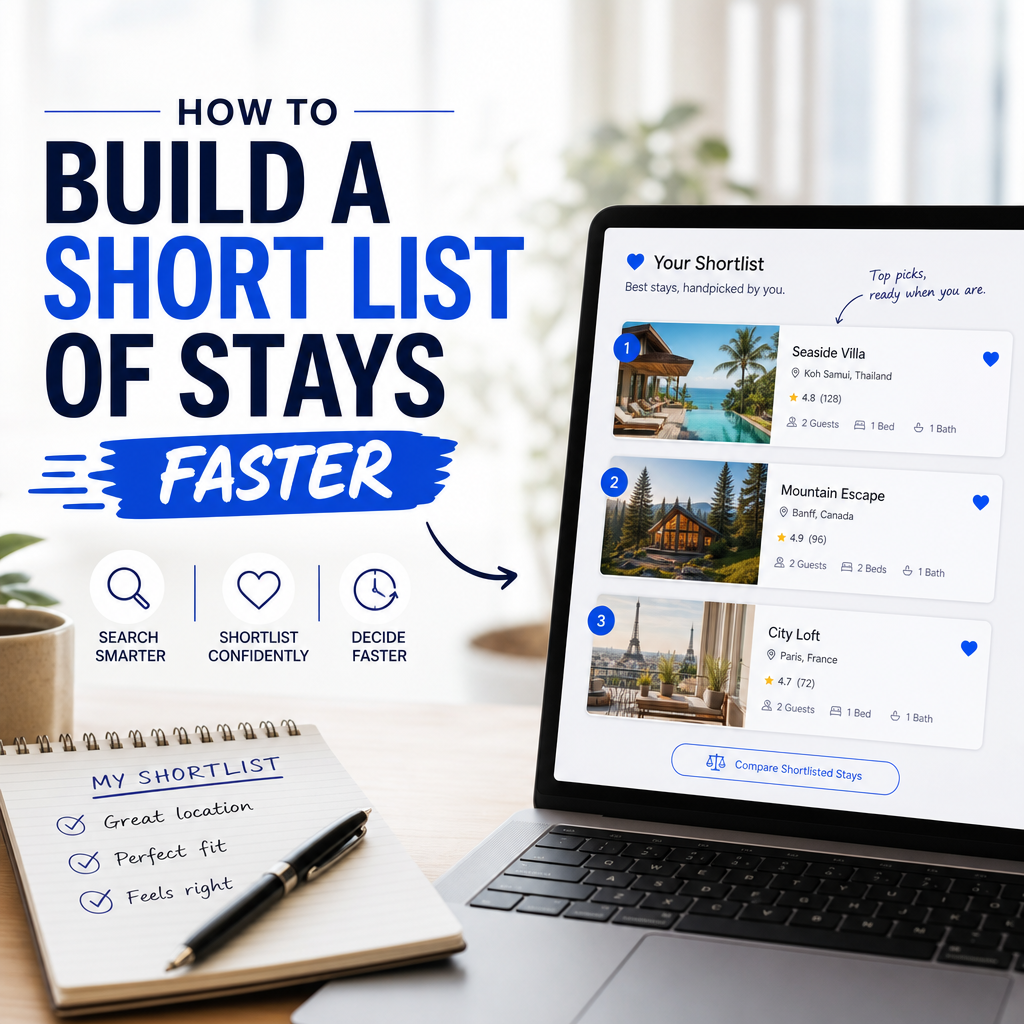
How to Build a Short List of Stays Faster
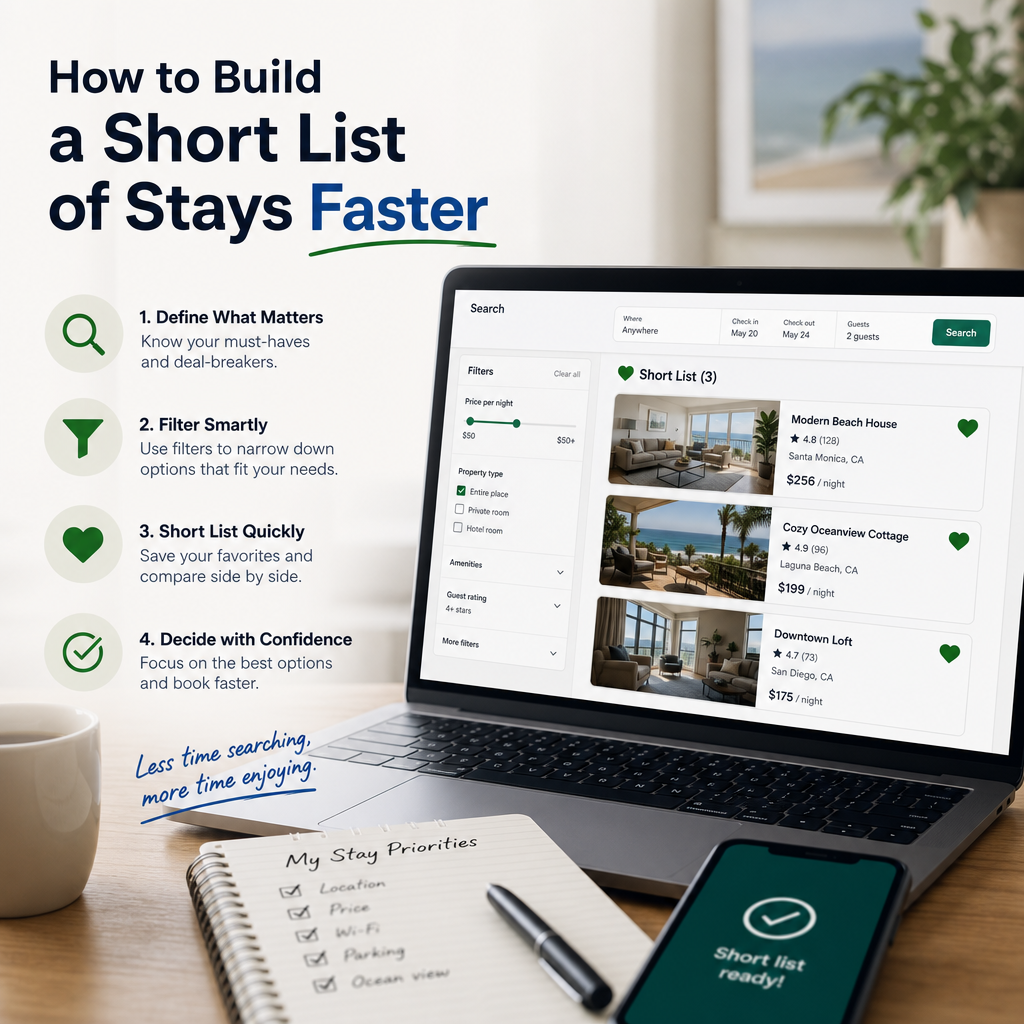
Searching for a place to stay can start out exciting and quickly become overwhelming. One minute you’re browsing a handful of charming hotels, apartments, and guesthouses. The next, you have 38 open tabs, a spreadsheet full of half-complete notes, and no clearer idea of which option is actually best.
The problem is rarely a lack of choices. It’s too many choices.
Whether you’re planning a weekend getaway, a business trip, a family vacation, or a long stay in a new city, the real skill is not finding every possible accommodation. It’s narrowing dozens of options into a short list you can actually compare with confidence.
That’s where a simple, repeatable process helps. Instead of trying to assess everything at once, you can filter step by step:
- Define your must-haves
- Remove obvious no’s
- Compare the total cost
- Inspect reviews
- Score the location
- Check policies
- Pick 3–5 finalists
This approach saves time, reduces decision fatigue, and makes the final choice feel much more manageable. Tools like StayMatch can make that comparison faster and less scattered by keeping your options, notes, and tradeoffs in one place.
Why Shortlisting Stays Feels So Hard
Accommodation search often becomes messy because each listing looks appealing in a different way. One place is cheaper, another is closer to the center, another has amazing reviews, and another offers flexible cancellation. It’s easy to keep “just in case” options open for too long.
Common reasons people struggle to shortlist include:
- Too many search filters used at once
- Inconsistent information across booking sites
- Hidden fees that change the price
- Conflicting reviews
- Difficulty comparing location, policies, and value side by side
- Fear of ruling out a “maybe good” option too early
The solution is not to spend more time researching every listing. The solution is to build a faster decision framework.
Step 1: Define Your Must-Haves
Before you compare any stays, decide what matters most. Your must-haves are the non-negotiable features your stay must have to work for the trip.
Examples of must-haves might include:
- Free cancellation
- Private bathroom
- Wi-Fi
- Kitchen or kitchenette
- Air conditioning
- Parking
- Pet-friendly rooms
- Family-sized rooms
- Elevator access
- Check-in after a certain time
For a business trip, your must-haves might be:
- Fast Wi-Fi
- Quiet workspace
- Easy transport access
- Flexible check-in
- Reliable reviews
For a family vacation, your list may look different:
- Two bedrooms or more
- Laundry facilities
- Safe neighborhood
- Kitchen
- Child-friendly policies
Keep this list short. If everything is a must-have, nothing is. Try to separate must-haves from nice-to-haves so you can make decisions quickly later.
A helpful rule: if an accommodation lacks any must-have, it does not make the short list.
Step 2: Filter Out the Obvious No’s
Once you know your must-haves, remove any listings that clearly do not fit. This step should be fast and ruthless.
Obvious no’s usually include:
- Wrong room type or too little space
- Budget far above your limit
- Poor location for your trip
- No cancellation flexibility when you need it
- Missing essential amenities
- Bad accessibility for someone in your group
- Policies that clash with your travel plans
For example, if you’re traveling for a conference and need to arrive late, a listing with a very strict check-in window may not work. If you’re bringing a child, a place with steep stairs and no elevator may be a no-go. If you’re planning multiple early mornings, a property far from transit may create unnecessary stress.
This stage is about removing options, not choosing winners. The goal is to reduce your list from dozens to a more realistic group of possibilities.
Step 3: Compare the Total Cost, Not Just the Nightly Rate
A common mistake is to focus on the advertised price per night and ignore the rest. The cheapest-looking option is not always the cheapest overall.
Always compare the full cost, including:
- Taxes
- Service fees
- Cleaning fees
- Resort fees
- Parking charges
- Extra person fees
- Breakfast add-ons
- Late check-in fees
- Security deposits
- Currency conversion differences
For example, a hotel listed at $140 per night might end up costing $175 after fees and parking. Meanwhile, a place listed at $155 might include parking, breakfast, and flexible cancellation, making it the better value.
When you compare total cost, ask yourself:
- What is the final price for the entire stay?
- What services are included?
- What will I likely pay extra for?
- Does a higher upfront price actually reduce other trip costs?
Sometimes the best stay is the one that feels expensive at first glance but ends up saving money and hassle.
Step 4: Inspect Reviews for Patterns, Not Just Scores
Review scores are useful, but they do not tell the whole story. A property with a 9.1 rating may still have issues that matter to you. A property with an 8.3 may be a better fit if the complaints are unrelated to your priorities.
Instead of reading every review, look for patterns.
Pay attention to repeated mentions of:
- Cleanliness
- Noise levels
- Staff helpfulness
- Accuracy of listing photos
- Wi-Fi reliability
- Bed comfort
- Shower quality
- Check-in experience
- Safety
- Response time from the host or property manager
A few negative reviews are normal. What matters is whether the same issue appears again and again.
For example:
- If multiple reviewers mention “paper-thin walls,” that matters for light sleepers.
- If several guests praise the host’s quick responses, that may reduce stress during your trip.
- If many people say the photos made the place look larger than it is, be cautious.
Read reviews with your trip in mind. A property might be fine for one traveler and frustrating for another. Business travelers, families, couples, and solo travelers often value different things.
Step 5: Score Location Based on Real Priorities
Location is one of the biggest factors in stay satisfaction, yet it’s often judged too vaguely. “Good location” means different things depending on the trip.
Rather than asking whether a stay is “central,” score it based on what you actually need.
Questions to consider:
- How far is it from the places I’ll visit most?
- Is it easy to reach by transit, walking, or car?
- Will I spend extra time or money commuting?
- Is the neighborhood safe and convenient at the times I’ll be out?
- Are there nearby groceries, cafes, or essentials?
- Is it quiet enough for sleep or work?
A great example is a city break. A hotel in the center may seem ideal, but if it’s directly above a busy nightlife street, sleep could be difficult. On the other hand, a property a little outside the center might offer better value, better rest, and only a short train ride to attractions.
A simple location score can help you compare options consistently. You might rate each stay from 1 to 5 on:
- Proximity to key destinations
- Transit access
- Neighborhood convenience
- Noise level
- Overall fit for the trip
This turns a vague “feels right” decision into something you can assess more objectively.
Step 6: Check Policies Before You Get Attached
Policies can make a stay either flexible and stress-free or restrictive and risky. It’s best to check them early, before you fall in love with the photos.
Important policies to review include:
- Cancellation terms
- Refund timing
- Deposit requirements
- Minimum stay rules
- Check-in and check-out times
- Pet policies
- Smoking policies
- Child or extra guest policies
- Identification requirements
- Damage or cleaning charges
Imagine booking a room that looks perfect, only to discover the cancellation window closes 24 hours after booking, or that there is a non-refundable deposit you didn’t expect. That can turn a promising option into a poor one.
Policies matter especially when your plans may change. If your travel dates are uncertain, flexibility may be worth paying a little more for. If you’re coordinating a group trip, strict house rules may be harder to manage.
Step 7: Narrow It Down to 3–5 Finalists
Once you’ve defined your must-haves, removed the no’s, compared cost, reviewed feedback, scored location, and checked policies, you should be left with a much smaller set of strong candidates.
Aim for 3–5 finalists.
Why this number?
- Fewer than 3 can leave you with too little choice
- More than 5 can bring back decision fatigue
- 3–5 is enough to compare meaningfully without getting lost again
At this stage, compare your finalists side by side. Ask:
- Which option has the best overall value?
- Which one best matches my priorities?
- Which one reduces trip stress the most?
- Which tradeoffs am I willing to accept?
You may find that your top choice is not the cheapest. It may simply be the one that best fits your trip with the fewest compromises.
A Simple Example of the Shortlisting Process
Let’s say you’re planning a four-night stay in Barcelona. You begin with 22 listings.
Your process might look like this:
Must-haves
- Private room or apartment
- Wi-Fi
- Air conditioning
- Close to public transport
- Budget under a set total
- Free cancellation
Remove obvious no’s
You eliminate listings with shared bathrooms, weak transit access, or no cancellation flexibility. That leaves 10 options.
Compare total cost
You discover that some lower nightly rates include large cleaning fees or extra guest charges. That reduces the practical contenders to 7.
Inspect reviews
You spot repeated complaints about noise and unreliable Wi-Fi at two properties. Now you’re down to 5.
Score location
You compare walking time to your planned attractions and metro stops. One property is cheaper but too far out. That leaves 4 finalists.
Check policies
One stay has a strict no-refund policy. You remove it, leaving 3 strong options.
Now you have a focused shortlist, not a mountain of choices.
That’s the difference between searching endlessly and making a confident decision.
How StayMatch Helps Make This Faster
Doing all of this manually across multiple tabs, listing pages, and notes can get messy fast. That’s where StayMatch can help.
StayMatch is designed to make accommodation comparison less scattered by keeping the key details in one place. Instead of jumping between websites and trying to remember which stay had the better location, lower fees, or more flexible policy, you can organize your options more efficiently.
With a tool like StayMatch, you can:
- Keep all potential stays in one shortlist
- Compare key details side by side
- Track must-haves and dealbreakers
- Review total cost more clearly
- Organize notes from reviews and policies
- Narrow choices without losing track of earlier research
The biggest advantage is speed with clarity. You’re not just collecting listings—you’re working through a decision process. That means fewer distractions, fewer missed details, and less backtracking.
Tips for Shortlisting Even Faster
If you want to make the process even smoother, try these habits:
Use a consistent template
Create the same checklist for every trip so you’re not reinventing the process each time.
Set a decision deadline
Give yourself a time limit for research. Too much browsing leads to overthinking.
Compare on the same criteria
Use the same factors for every stay so the comparison is fair.
Don’t overvalue “perfect”
Every accommodation has tradeoffs. Focus on the best fit, not the flawless listing.
Separate emotional appeal from practical value
A stylish photo can be tempting, but it should not replace solid basics like location, cost, and policies.
Conclusion
Building a short list of stays does not have to be a long, chaotic process. The key is to move in steps: define your must-haves, eliminate obvious no’s, compare the total cost, inspect reviews, score the location, check the policies, and then narrow it down to 3–5 finalists.
That simple structure helps you focus on what actually matters for your trip. It also makes it easier to choose with confidence instead of second-guessing every option.
With a tool like StayMatch, you can keep that comparison organized and faster, so the search feels less scattered and more intentional. In the end, the best stay is not the one you spend the most time hunting for—it’s the one you can confidently identify, compare, and book without the stress.